

 English
 China
China Thailand
 Malaysia
 Vietnam
 Laos
Laos Cambodia
 Pilipinas
 Indonesia
 Russian
 Portuguese
 Arabic
 Japanese
 Spanish
 Italian
 French
 German
News
- Home
- News
- Company News
Geogrid mesh plays a crucial role in soil stabilization, providing a solution to challenges such as erosion, structural instability, and uneven settlement. This report explores how geogrids function within the context of soil reinforcement, focusing on their application alongside anti-climb fences for enhanced security and stability. The discussion will cover the principles behind geogrid technology, its integration with other construction materials, and the benefits it offers in terms of durability and cost-effectiveness. Additionally, we'll examine case studies where geogrids have been successfully implemented, highlighting the importance of proper design and installation techniques.
Geogrids are engineered polymeric materials designed to provide tensile strength to soils, improving their load-bearing capacity and reducing deformation. They work by interlocking with the surrounding soil particles, creating a composite structure that distributes loads more evenly. This mechanism is particularly effective in areas prone to sliding or where additional support is needed beneath structures like roads, retaining walls, or even around the foundations of anti-climb fences.
There are primarily two types of geogrids: uniaxial and biaxial. Uniaxial geogrids offer high strength in one direction, making them ideal for applications requiring linear reinforcement, such as slope stabilization. Biaxial geogrids, on the other hand, provide strength in both longitudinal and transverse directions, which is beneficial for base reinforcement under pavements or for stabilizing wide areas. Both types can be used in conjunction with anti-climb fences to ensure a secure and stable perimeter.
When geogrids are placed between layers of aggregate, they create a mechanically stabilized layer (MSL) that enhances the overall performance of the system. The MSL acts as a flexible mat, distributing loads over a larger area, thereby reducing the stress on the underlying soil. This is especially useful in constructing stable bases for anti-climb fences, ensuring that the fence remains upright and secure against potential threats.
Incorporating geogrids into concrete structures, such as retaining walls, can significantly improve their stability and longevity. By placing geogrids within the backfill material, the wall's resistance to lateral earth pressure is increased, preventing bulging or collapse. This technique is also applicable to the foundation of anti-climb fences, where geogrids can help anchor the fence posts firmly into the ground, enhancing the overall security of the perimeter.
One of the primary advantages of using geogrids is their ability to extend the lifespan of infrastructure projects. By reinforcing the soil, geogrids reduce the risk of failure due to settling, erosion, or excessive loading. This is particularly important for critical structures like anti-climb fences, where maintaining integrity over time is essential for continued security. Geogrids also minimize the need for frequent maintenance, leading to long-term cost savings.
Although the initial investment in geogrids may seem higher compared to traditional methods, the long-term benefits often outweigh the costs. Geogrids can reduce the thickness of required pavement layers, leading to lower material and labor expenses. Furthermore, their use promotes sustainability by minimizing the environmental impact associated with resource-intensive construction practices. In the context of anti-climb fences, geogrids can help create a more robust and durable perimeter, reducing the need for frequent repairs or replacements.
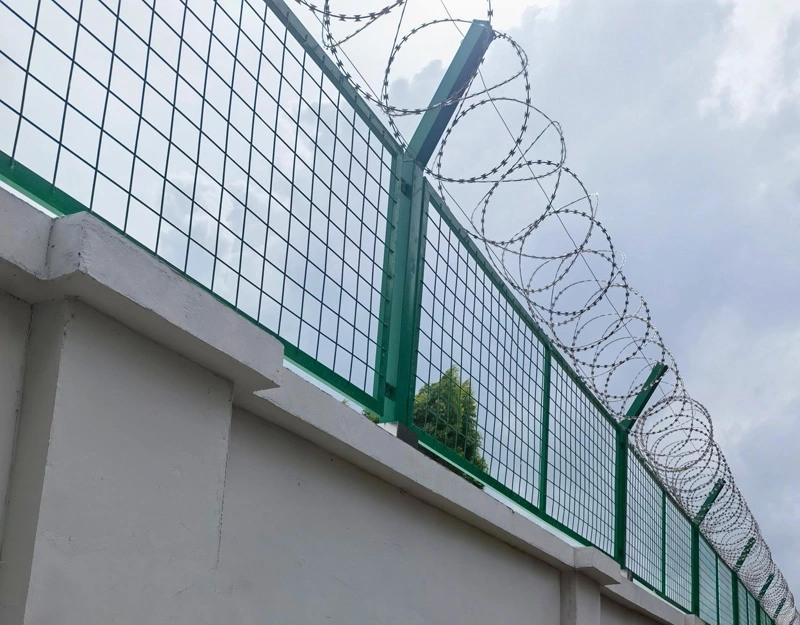
A notable example of geogrids in action is the stabilization of slopes and embankments. In a project involving a steep hillside adjacent to a highway, geogrids were installed to prevent landslides and ensure the safety of the road. The geogrids were integrated with a layer of compacted soil, creating a reinforced mass that resisted the downward force of gravity. This approach not only provided a stable foundation but also allowed for the installation of an anti-climb fence along the top of the slope, enhancing the security of the area.
In another case study, geogrids were used to reinforce the foundation of an anti-climb fence in a high-security facility. The site was characterized by soft, unstable soil, which posed a significant challenge for the fence's stability. By incorporating geogrids into the foundation, the fence posts were anchored securely, preventing any tilting or displacement. The geogrids also helped distribute the weight of the fence more evenly, ensuring that the entire structure remained stable and secure.
The success of geogrids in soil stabilization depends heavily on proper design. Engineers must consider factors such as the type of soil, the anticipated loads, and the specific requirements of the project. For instance, in the case of anti-climb fences, the design should account for the weight of the fence, the potential for wind loads, and the need for a stable foundation. Accurate calculations and the selection of the appropriate geogrid type are crucial for achieving the desired results.
Effective installation is equally important for the performance of geogrids. The geogrids should be laid out carefully, ensuring that they are properly aligned and tensioned. In the context of anti-climb fences, this means placing the geogrids in the correct position relative to the fence posts and ensuring that they are securely fastened. Proper compaction of the soil and aggregate layers is also essential to achieve the desired level of reinforcement. Following these best practices will ensure that the geogrids provide the necessary support and stability for the project.
As material science continues to advance, new and improved geogrids are being developed. These innovations include geogrids made from more durable and environmentally friendly materials, as well as those with enhanced tensile strength and flexibility. These advancements will further enhance the effectiveness of geogrids in various applications, including the stabilization of soil around anti-climb fences. The development of smart geogrids that can monitor and report on soil conditions in real-time is also on the horizon, offering even greater control and precision in soil stabilization projects.
The integration of geogrids with digital technologies, such as sensors and data analytics, is another exciting trend. These technologies can provide real-time monitoring of soil conditions, allowing for proactive maintenance and adjustments. For example, sensors embedded in geogrids can detect changes in soil moisture, temperature, and pressure, alerting engineers to potential issues before they become critical. This integration is particularly valuable for high-security applications, such as anti-climb fences, where maintaining the integrity of the perimeter is paramount.

Leave a Reply