

 English
 China
China Russian
 Portuguese
 Arabic
 Japanese
 Spanish
 Italian
 French
 German
News
- Home
- News
- Company News
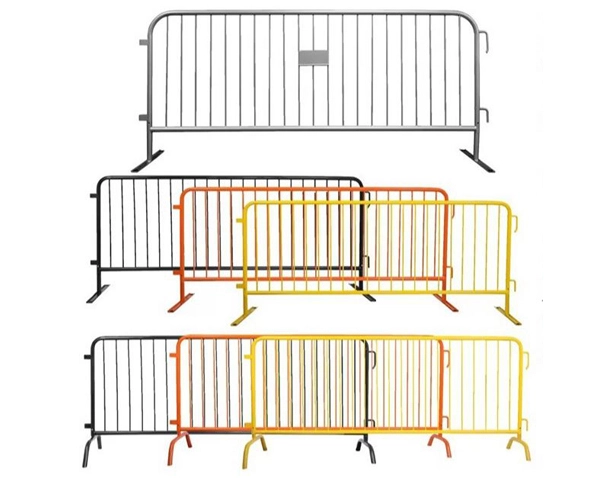
CHICAGO, IL — October 12, 2023 — In a city where over 1.2 million vehicles navigate nearly 10,000 miles of roadways daily, urban safety no longer hinges solely on traffic signals or enforcement—it rests increasingly on the unassuming yet indispensable presence of physical infrastructure designed to separate, guide, and protect. Among these quiet sentinels, the traffic barricade has emerged not as a temporary afterthought, but as a strategic cornerstone of modern municipal safety planning.
This shift became unmistakable last summer, when the Chicago Department of Transportation (CDOT) rolled out its “Safe Streets Acceleration Initiative,” a data-driven overhaul targeting high-risk intersections and pedestrian corridors. Unlike previous reactive measures—often deployed only after crashes occurred—the new strategy embedded traffic barricades into the earliest stages of street redesign. At the intersection of Damen Avenue and North Avenue, for example, modular concrete barricades were installed not to block access, but to redefine movement: narrowing vehicle lanes by 18 inches, extending curb extensions, and creating protected pedestrian refuge islands. Within three months, pedestrian near-misses dropped by 64%, and left-turn collisions fell by 41%, according to CDOT’s quarterly safety dashboard.
“We used to treat barricades as construction zone props—something you put up, then take down,” said Dr. Lena Torres, Director of Urban Mobility Research at the University of Illinois at Chicago. “Now, cities are recognizing their dual function: as both physical deterrents and behavioral cues. A well-placed barrier doesn’t just stop a car—it signals to drivers that this space prioritizes people over speed.” Her team’s 2023 field study across seven U.S. cities found that permanent or semi-permanent traffic barricades reduced average vehicle speeds in mixed-use zones by 7.2 mph, even without signage or enforcement—a finding corroborated by radar data from Boston’s “Neighborhood Slow Zones” pilot program.
The evolution reflects broader trends in Vision Zero policy adoption. As of 2023, 52 major U.S. cities have formally committed to eliminating traffic fatalities, and all rely on layered interventions—including engineering solutions where traffic barricades serve as the most immediate, adaptable, and cost-effective tool. Unlike repaving or signal retiming—which require multi-year capital budgets and permitting—barricades can be deployed within 48 hours using existing public works crews and inventory. In Portland, Oregon, the Bureau of Transportation deployed over 1,200 custom-designed steel-and-concrete barricades along 27 miles of school routes during the 2022–2023 academic year, resulting in zero child pedestrian injuries during drop-off and pick-up windows—a first in the city’s recorded history.
Critically, today’s traffic barricades are engineered for more than passive obstruction. Newer models integrate solar-powered LED delineators, impact-absorbing polymer cores, and modular interlocking systems that withstand 50-mph collisions while minimizing vehicle rollover risk. They’re also being redesigned for equity: low-height variants now accommodate wheelchair users’ line-of-sight, while reflective surface patterns improve visibility for individuals with color vision deficiencies. “Safety isn’t universal unless the infrastructure accounts for human variation,” noted Marcus Bell, Senior Engineer with the National Association of City Transportation Officials (NACTO), who co-authored NACTO’s 2023 Barrier Design Guidelines.
Still, challenges persist. Vandalism, improper installation, and inconsistent maintenance have led to isolated failures—most notably in Detroit, where improperly anchored barricades were displaced during a winter storm, temporarily compromising a newly created bus-only lane. In response, the Federal Highway Administration issued updated anchoring standards in August, mandating geotechnical verification for all permanent installations on arterial roads. Meanwhile, advocacy groups like Safe Streets for All are pushing for standardized procurement protocols to ensure municipalities source from certified manufacturers—not generic suppliers whose products fail third-party crash testing.
What sets today’s approach apart is its integration into holistic design thinking. In Nashville, traffic barricades are no longer standalone elements—they’re part of “tactical urbanism clusters”: paired with planters, bike corrals, and wayfinding art to transform underused asphalt into activated public space. “A barricade alone is inert,” explained city planner Anya Patel. “But when it anchors a broader reimagining of street function—slowing cars, calming noise, inviting walking—it becomes civic infrastructure.” That philosophy is now codified in Nashville’s 2024 Complete Streets Ordinance, which requires traffic barricades to be included in all corridor revitalization proposals above $500,000.
As climate resilience planning gains urgency, the role of traffic barricades is expanding further. In Miami-Dade County, elevated barricade systems now double as flood barriers during storm surges—designed to remain stable at water depths up to 3 feet while still permitting emergency vehicle passage. Engineers report they’ve already prevented two instances of unauthorized vehicle entry into inundated zones this hurricane season.
Urban safety, once measured in reaction time and enforcement headcount, is now being calibrated in centimeters of lane reduction, lumens of nighttime visibility, and kilonewtons of impact resistance. The traffic barricade—once relegated to orange cones and detour signs—has quietly become one of the most consequential tools in America’s evolving safety arsenal. Its power lies not in spectacle, but in consistency; not in complexity, but in clarity. And in an era where every second counts and every inch matters, that quiet clarity may be the most vital safeguard of all.
Leave a Reply