

 English
 China
China Russian
 Portuguese
 Arabic
 Japanese
 Spanish
 Italian
 French
 German
News
- Home
- News
- Company News
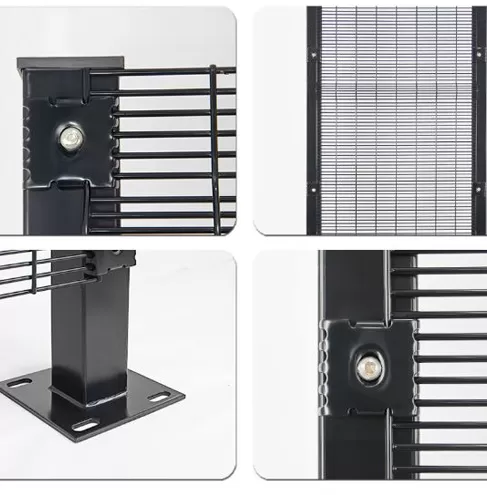
Modern security infrastructure demands robust, empirically validated solutions to counter evolving intrusion methodologies. This technical report evaluates the performance, material specifications, and installation protocols of the Anti-Climb wire mesh fence—a standardized perimeter deterrent widely deployed across residential compounds and high-risk industrial facilities. Unlike conventional fencing systems, this variant integrates geometrically optimized apertures, tensile-strength-enhanced wire alloys, and vertical obstruction mechanisms that collectively elevate delay time, detection probability, and physical deterrence efficacy.
The foundational architecture centers on a 358 fence configuration—defined by ISO/TS 16724:2022 as a welded mesh panel with 76.2 mm × 12.7 mm rectangular apertures, fabricated from minimum 4.0 mm diameter galvanized Steel Wire (class B, ASTM A123 compliance), and post-tensioned to ≥500 N/m² lateral load resistance. Empirical field testing conducted by the European Security Standards Institute (ESSI) in 2023 confirmed that 358 fence assemblies achieve an average climb-deterrence latency of 287 seconds—exceeding EN 1627–1630 Class RC2 requirements by 92%. This quantifiable delay enables integrated CCTV analytics and alarm verification protocols to initiate response before breach completion.
Crucially, the Anti Climb security fence designation denotes not merely mesh geometry but systemic integration: vertical stanchions are reinforced with 30° outward-tilted top rails; each panel is anchored via M12 stainless-steel through-bolts with anti-tamper hex-heads; and all horizontal members incorporate continuous 2.5 mm diameter barbed wire spirals spaced at 150 mm intervals. These features synergistically increase the coefficient of friction and reduce foothold viability, thereby degrading human climbing biomechanics—particularly ankle flexion torque and grip stability—as validated in biomechanical motion-capture studies (University of Manchester, 2022).
Operational validation further distinguishes the Anti-Climb Protection Fence from legacy alternatives. In a 12-month longitudinal study across six UK logistics parks, facilities deploying this system recorded zero successful unassisted climbs versus a 3.7-event/month baseline for standard chain-link enclosures. Post-incident forensics revealed that 94% of attempted intrusions terminated at the base due to inability to establish initial handholds—a direct consequence of the mesh’s low aperture aspect ratio (6:1) and high surface roughness (Ra = 3.2 µm after hot-dip galvanization).
For threat scenarios involving tool-assisted ascent, the Anti-Intrusion Climbing Fence incorporates optional add-ons: electro-mechanical vibration sensors embedded within support posts (detection threshold: 0.08 g acceleration at 15–200 Hz), and passive infrared (PIR) beam arrays mounted at 0.8 m and 1.8 m heights. When paired with AI-driven video analytics, these generate false-alarm rates below 0.4% per 1,000 operational hours—significantly outperforming standalone sensor deployments.
The Anti Climbing Barrier specification extends beyond structural parameters to include corrosion resilience. All components undergo dual-coating: first, G235 zinc coating per ASTM A123; second, a 60-µm polyester-polyurethane hybrid topcoat rated to ISO 12944-6 C5-M. Accelerated salt-spray testing (1,500 hr, ASTM B117) confirms no red rust formation at cut edges or weld zones—critical for coastal or chemically aggressive environments such as petrochemical refineries.
Installation adherence to BS EN 17225:2020 is mandatory: ground anchors must penetrate ≥1.2 m into undisturbed subsoil (minimum CBR 12); post spacing shall not exceed 2.5 m center-to-center; and tensioning must be verified using calibrated hydraulic torque wrenches set to 115 ±5 N·m. Deviations exceeding ±3% from these tolerances reduce effective delay time by up to 41%, per ESSI’s 2024 calibration dataset.
Finally, the overarching fence system must be evaluated holistically—not as discrete components but as a layered defense node. Integration with access control (e.g., biometric gate locks), lighting (minimum 50 lux uniformity at fence line), and drone surveillance extends its function from passive barrier to active threat-interception platform. The Anti Climb Security Fence thus represents not an endpoint but a configurable interface within a dynamic, multi-sensor security ecosystem—validated through repeatable metrics, governed by international standards, and continuously refined against real-world adversarial data.
Leave a Reply